09 juli 2009

Pyke Kock

Soms is het slim de tekst op je website eens door iemand anders te laten lezen, zeker als je het een en ander pretendeert (zie onder de afbeelding).


Artwijs:
Abstracte kunst? Dat kan mijn kleine zusje ook... Wat vind ik van kunst, wat is de functie van kunst en waarom zou ik naar een museum gaan. Dat zijn vragen die in Artwijs aan de orde komen. Deze website is bedoeld voor leerlingen en docenten als voorbereiding op het debat in het museum. Per museum/lesniveau vind je stromingen en kunstenaars met daaraan stellingen gekoppeld als oefenmateriaal.

--

Pyke Koch (Wikipedia)

Mohawk Ironworkers, Walking High Steel


"A lot of people think Mohawks aren’t afraid of heights; that’s not true. We have as much fear as the next guy. The difference is that we deal with it better. We also have the experience of the old timers to follow and the responsibility to lead the younger guys. There’s pride in walking iron."

- Kyle Karonhiaktatie Beauvais, Mohawk, Kahnawake


Van The Straight Dope:

Why do so many Native Americans work on skyscrapers?

The Mohawks got into the business by happenstance. In 1886 a Canadian company was building a railroad bridge over the St. Lawrence river near the Kahnawake reservation. The company hired a number of Mohawks as day laborers, but found they loved to climb around on the ironwork without any apparent fear of heights. Since it was difficult to find men with the moxie for high work, the company decided to try an Indian crew. "We picked out some and gave them a little training, and it turned out that putting riveting tools in their hands was like putting ham with eggs," a company official later wrote. Mohawks helped build bridges from then on.

In 1907 96 men were killed when a span of the Quebec Bridge collapsed during construction; 35 of them were Indians from Kahnawake. The dead were buried in the Kahnawake cemetery under crosses made of steel beams. Your average construction worker might have decided it was time to go into a safer line of work, but not the Mohawks. From that day forward every young male on the reservation was convinced that risking your neck on high steel was the coolest calling this world could offer.

The Mohawks eventually branched out from bridges into general steel construction, including office buildings. During the late 1920s a number of Kahnawake crews started working on skyscrapers in New York, and they've been a fixture of the city's construction scene ever since. Some crews--the members are often related to one another--spend the weekends on the reservation and drive down to New York for the week; others live in Brooklyn. But they'll travel anywhere if there's steel to climb.

De Amerikaanse blonde vrouwenschrijver uit de klassieke oudheid stelt op zwarte ruimte

nl.dreamstime.com:

De Amerikaanse blonde vrouwenschrijver uit de klassieke oudheid stelt op zwarte ruimte
Bestand info: (Instructies voor het comping)

Beschrijving:
De Amerikaanse blonde vrouwenschrijver uit de klassieke oudheid stelt op zwarte ruimte

--

Sommige vertalingen komen van een geautomatiseerd systeem en bevatten mogelijk fouten.

Ge-ja!-zing

Vermoeiend jaologisme:

ge-ja!zing

Le monde de la Francophone

Le monde de la Francophone volgens de Organisation internationale de la Francophonie:


De iets realistischer kijk van de World Language Fair for Educators:

Dan maar niets

Of hoe een probleem waarover je de laatste tijd geregeld kunt horen, helemaal niet zo nieuw blijkt te zijn.

--

Uit:
Machines en emoties
Willem Frederik Hermans - Rudy Kousbroek - Ethel Portnoy
Een briefwisseling, bezorgd door Willem Otterspeer

Willem Frederik Hermans aan Rudy Kousbroek en Ethel Portnoy, 27 juni 1965

[...]
Het paradijs op dit gebied is Londen. Rondkijkend in een tijdschriftenwinkeltje, werd ik door de conservator naar zijn kantoortje gewenkt, waar schoenendozenvol stonden met kiekjes die de man – een Griek, denk ik – schenen te noodzaken van gebroken Engels in gebroken Duits over te gaan. Prijs: 1 pond per vier stuks. Hij had ook 8 mm filmpjes, stapels, die geweldig waren, zei hij. Maar ik ben ten prooi gevallen aan een van mijn minder gunstige eigenschappen: altijd als mij iets in overmaat wordt aangeboden, weet ik geen keus meer te maken en neem niets.

Omslag Machines en emoties

Google Classic


08 juli 2009

Old Pictures

old-picture.com:


Welcome to the Old Picture internet site, featuring an extensive collection of historical photographs. This collection includes images from the years 1850 to 1940. These photographs span the globe, and present a unique view of our past. Join us in developing a love and appreciation for vintage photographs.
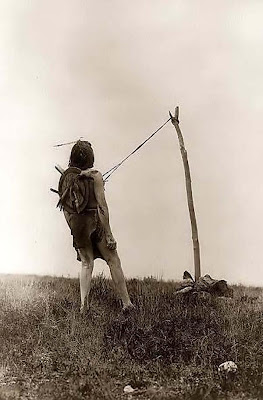

Indian Chest Piercing Sun Dance Ritual

Here is an original photograph of an Indian Ceremony in which a man is suspended by leather straps attached to sticks in his chest. It was created in 1908 by Edward S. Curtis. The photograph illustrates a Crow man, leaning back slightly, with strips of leather attached to his chest by sticks pierced through his breast. He is tethered to a pole that is secured by rocks. This is all part of the piercing ritual of the sun dance.


Captain Cuninghame, 42nd Royal Highland Regiment in Uniform

Here is an exciting picture of Captain Cuninghame, 42nd Regiment in Crimean War. It was taken between 1855 and 1865 by Fenton, Roger, 1819-1869. The illustration illustrates Captain Cuninghame, 42nd Royal Highland Regiment, full-length portrait, wearing uniform, standing, facing front, in front of a bell tent.
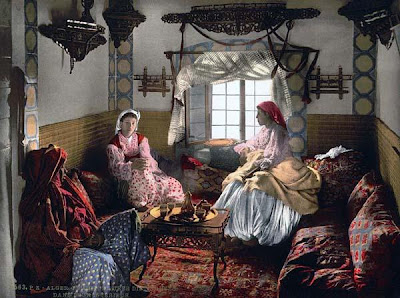

Distinguished Moorish women, Algiers, Algeria
Distinguished Moorish women, Algiers

You are viewing a rare image of Distinguished Moorish women, Algiers, Algeria. This color photochrome print was taken in 1899 in Algiers.


Old Pictures
Old Picture of the Day
 

07 juli 2009

Double Vision

Uit Wired:


(Klik voor een grotere versie.)
--

Look at the picture above and you see Albert Einstein. Now walk across the room. Suddenly, he morphs into Marilyn Monroe. Trippy, right? Aude Oliva, an associate professor of cognitive science at MIT, uses images like this one to study how our brains make sense of sight.

Our eyes pick up resolutions with both high spatial frequencies (sharp lines) and low ones (blurred shapes). By blending the high frequencies from one picture with the lows from another, Oliva creates images that change as a function of distance and time—allowing her to parse how humans absorb visual information. Turns out that we perceive coarse features quickly, within the first 30 milliseconds, and then home in on details at around 100 milliseconds. We also focus on the higher frequencies close up and register softer shapes from afar.

"It's something we never think about," Oliva says. "But we still don't know how our brains digest new images so seamlessly and so rapidly." The answer could help treat cognitive disorders or assist in the development of more-perceptive bots. Because, let's be honest: What good is a robot if it can't tell the difference between a sexy, troubled icon and Marilyn Monroe?